Cory Doctorow’s “Reverse Centaurs Guide to Life After AI” has a short section that pertains to this. He talks about how someone like Linus essentially doesn’t have a boss and has untold resources for whatever “AI” “tools” he finds useful.
He isn’t ever forced to use the wrong tool for the job or use a tool that simply doesn’t do what his boss thinks it does. He doesn’t have to worry about getting fired or his coworkers getting fired because his boss was sold a story about reducing labor costs with this cool new “tool”. He simply uses what’s useful to him with the probably millions of dollars of compute made available to him by the tech giants.
95% of people don’t have that luxury. They have a boss itching to get rid of them or 10x their workload with the help of the “tool” that Linus is so happily and defiantly praising on behalf of the monopolists.
I think there’s a broader question here from an evolutionary perspective. Humans are fundamentally tool users, and technology has been central to our development as a species. It’s possible that this evolutionary niche we’ve occupied will eventually reach its limits and contribute to our own downfall, but I’m not convinced AI is uniquely responsible. It’s part of a much longer trajectory of technological progress.
We’ve evolved to solve problems and use tools to make our lives easier. That doesn’t mean technological progress is inevitable, but these tendencies, combined with competition, make it difficult to imagine us ever really stopping. Even if we stopped today, who’s to say another generation of humans 10,000 years from now wouldn’t continue down the same path?
I don’t think this is exclusively about capitalism. Capitalism certainly incentivizes growth and reducing labor costs, but competition, greed, and the pursuit of technological advantages have existed under other economic systems too. That doesn’t diminish the legitimate concerns about how AI is being used against workers.
I also wonder whether our short lifespans make us particularly bad at considering the long-term consequences of our innovations. Who is going to sacrifice the opportunities of their own generation to prevent a possible catastrophe centuries from now, especially when there’s no guarantee it would stop technological progress?
I have a degree in psychology and particularly enjoyed evolutionary psychology, so I think it’s worth asking whether the deeper problem is our own nature, and whether our capacity for collective restraint can keep pace with our ability to innovate.
I know this raises more questions than it answers, but we’ve faced civilization-changing technologies before, from the printing press and electricity to nuclear weapons. AI won’t be the last. Perhaps the more important question is how we learn to manage these transformations when our tendency to create them seems so deeply rooted in who we are.
This argument is conflating the bad boss with the misattribution of the tool. You could do that for any tool throughout history. But I still fail to see how you go from “bad boss is bad because they make us misattribute tool” to “good boss is bad because he’s not wallowing with me about how bad boss is bad”.
As anyone who has known about him for more than a couple of years knows, Linus has a pretty solid track record of calling out stupidity. It’s just virtually always stupidity that affects the kernel. If he had to stop and tell bosses at other companies how to operate, Linux never would have made it out of the 90s.
What’s the point of this argument though? Sure it’s real for every profession and every tool but what’s the agentic choice we ought to pursue here? Whine against AI or actually lead society with policy? As “ban llm” is not a valid policy that would ever work so the only viable path is regulation and growing of culture where AI is used for good, no?
Embrace AI, work towards open weight/free software and protect worker rights. Society wins at the bleeding edge not at conservstism.
The answer is certainly not to embrace “AI” in it’s current forms or allow for big tech monopolists to continue their wasteful and destructive infrastructure buildout. The oligarchy isn’t going to regulate itself to worker self-determination either. Nothing short of the death of capitalism will do.
I don’t see how this means he’s wrong though, if people are hating AI as a proxy for hating their abusive relationship with their employer, that doesn’t seem like a strong argument that everyone who isn’t in that situation must also hate AI.
It doesn’t mean he’s wrong! it means he’s out of touch and doing the propaganda work of capital for free much like many other self-employed/business owning/petit-borgeois people who think they’re on the side of capital.
It also means that his praise for and indeed positive experience with this “tool” is largely irrelevant to the broader social/economic discourse surrounding so called AI.
Blind hatred for AI as a technology is inherantly reactionary, but that doesn’t mean that the implementation of the technology today isn’t problematic in many ways.
Yeah I notice he doesn’t address the costs, economic and environmental, of LLM proliferation. Way to ignore a large part of the argument while calling anyone opposed to your position stupid.
I hope he gets to eat those words one day, but I doubt he would ever admit he was wrong.
Then the picture would be significantly changed if the cost of running useful LLMs goes down to what it costs to acquire a reasonable computer to work on the Linux kernel, no? That is if we could run useful LLMs for kernel programming on our kernel programming computers, and we own those LLMs. In such a world, capital would have no stronger leverage over us than it already does by selling us the computers we need to program. Does this argument make sense?
It also means that his praise for and indeed positive experience with this “tool” is largely irrelevant to the broader social/economic discourse surrounding so called AI.
Yeah, but tbf all of the statements he’s making about it are in the context of organizing linux development and the most effective way to carry that out, and just happen to be public and so end up being widely republished and incorporated into discussions with a broader topic than that.
Shush! They are not supposed to know that the AI–Anti-Ai fight is fabricated bullshit with both sides being equally stupid (like people arguing based on ideological zeal always are…). And that it’s just a show so that the majority is occupied with watching the mud fight so they don’t think about the actual problem.


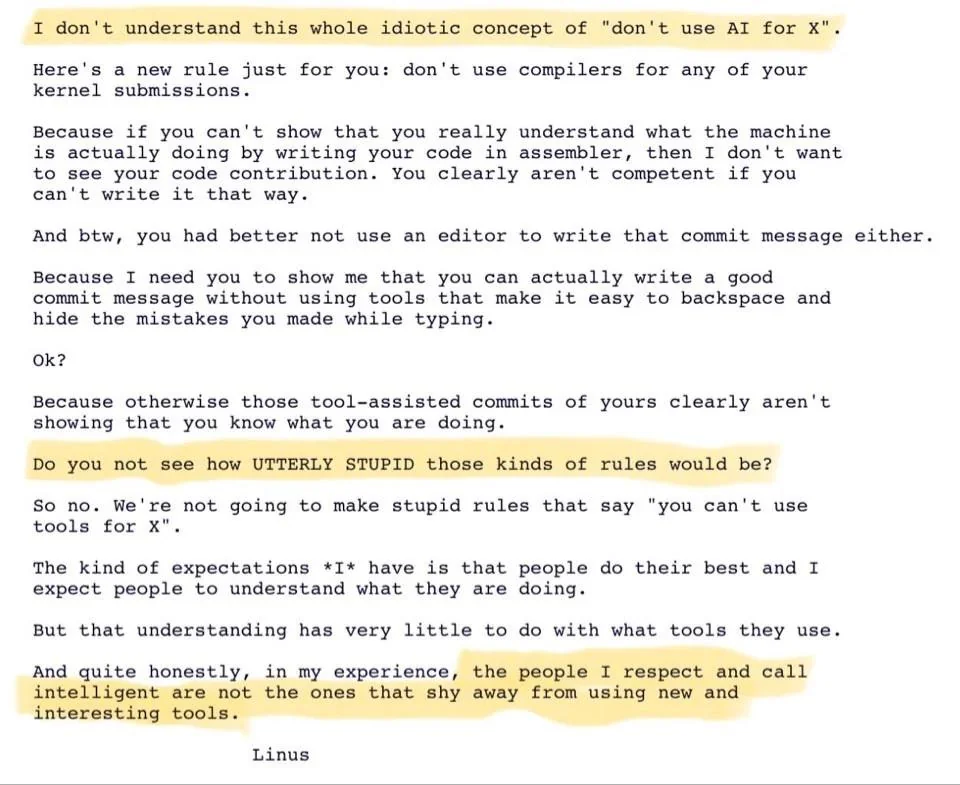
Cory Doctorow’s “Reverse Centaurs Guide to Life After AI” has a short section that pertains to this. He talks about how someone like Linus essentially doesn’t have a boss and has untold resources for whatever “AI” “tools” he finds useful.
He isn’t ever forced to use the wrong tool for the job or use a tool that simply doesn’t do what his boss thinks it does. He doesn’t have to worry about getting fired or his coworkers getting fired because his boss was sold a story about reducing labor costs with this cool new “tool”. He simply uses what’s useful to him with the probably millions of dollars of compute made available to him by the tech giants.
95% of people don’t have that luxury. They have a boss itching to get rid of them or 10x their workload with the help of the “tool” that Linus is so happily and defiantly praising on behalf of the monopolists.
I think there’s a broader question here from an evolutionary perspective. Humans are fundamentally tool users, and technology has been central to our development as a species. It’s possible that this evolutionary niche we’ve occupied will eventually reach its limits and contribute to our own downfall, but I’m not convinced AI is uniquely responsible. It’s part of a much longer trajectory of technological progress.
We’ve evolved to solve problems and use tools to make our lives easier. That doesn’t mean technological progress is inevitable, but these tendencies, combined with competition, make it difficult to imagine us ever really stopping. Even if we stopped today, who’s to say another generation of humans 10,000 years from now wouldn’t continue down the same path?
I don’t think this is exclusively about capitalism. Capitalism certainly incentivizes growth and reducing labor costs, but competition, greed, and the pursuit of technological advantages have existed under other economic systems too. That doesn’t diminish the legitimate concerns about how AI is being used against workers.
I also wonder whether our short lifespans make us particularly bad at considering the long-term consequences of our innovations. Who is going to sacrifice the opportunities of their own generation to prevent a possible catastrophe centuries from now, especially when there’s no guarantee it would stop technological progress?
I have a degree in psychology and particularly enjoyed evolutionary psychology, so I think it’s worth asking whether the deeper problem is our own nature, and whether our capacity for collective restraint can keep pace with our ability to innovate.
I know this raises more questions than it answers, but we’ve faced civilization-changing technologies before, from the printing press and electricity to nuclear weapons. AI won’t be the last. Perhaps the more important question is how we learn to manage these transformations when our tendency to create them seems so deeply rooted in who we are.
This argument is conflating the bad boss with the misattribution of the tool. You could do that for any tool throughout history. But I still fail to see how you go from “bad boss is bad because they make us misattribute tool” to “good boss is bad because he’s not wallowing with me about how bad boss is bad”.
As anyone who has known about him for more than a couple of years knows, Linus has a pretty solid track record of calling out stupidity. It’s just virtually always stupidity that affects the kernel. If he had to stop and tell bosses at other companies how to operate, Linux never would have made it out of the 90s.
What’s the point of this argument though? Sure it’s real for every profession and every tool but what’s the agentic choice we ought to pursue here? Whine against AI or actually lead society with policy? As “ban llm” is not a valid policy that would ever work so the only viable path is regulation and growing of culture where AI is used for good, no?
Embrace AI, work towards open weight/free software and protect worker rights. Society wins at the bleeding edge not at conservstism.
The answer is certainly not to embrace “AI” in it’s current forms or allow for big tech monopolists to continue their wasteful and destructive infrastructure buildout. The oligarchy isn’t going to regulate itself to worker self-determination either. Nothing short of the death of capitalism will do.
I don’t see how this means he’s wrong though, if people are hating AI as a proxy for hating their abusive relationship with their employer, that doesn’t seem like a strong argument that everyone who isn’t in that situation must also hate AI.
It doesn’t mean he’s wrong! it means he’s out of touch and doing the propaganda work of capital for free much like many other self-employed/business owning/petit-borgeois people who think they’re on the side of capital.
It also means that his praise for and indeed positive experience with this “tool” is largely irrelevant to the broader social/economic discourse surrounding so called AI.
Blind hatred for AI as a technology is inherantly reactionary, but that doesn’t mean that the implementation of the technology today isn’t problematic in many ways.
Yeah I notice he doesn’t address the costs, economic and environmental, of LLM proliferation. Way to ignore a large part of the argument while calling anyone opposed to your position stupid.
I hope he gets to eat those words one day, but I doubt he would ever admit he was wrong.
@TwiddleTwaddle@lemmy.blahaj.zone
I hope you were shamed by this reply, on the use of commas in a subordinate clause.
Hahaha my writing style is runon and compound complex sentences without commas.
Oh my god a reasonable take for once. Thank you for putting into words why his heel-turn has bothered me so much
It’s funny, the c/fuckai mod that banned me a while back said the same thing. Iirc it was “How very reasonable of you. Banned”
One should look at China when they’re concerned about the USA approach.
Then the picture would be significantly changed if the cost of running useful LLMs goes down to what it costs to acquire a reasonable computer to work on the Linux kernel, no? That is if we could run useful LLMs for kernel programming on our kernel programming computers, and we own those LLMs. In such a world, capital would have no stronger leverage over us than it already does by selling us the computers we need to program. Does this argument make sense?
Yeah, but tbf all of the statements he’s making about it are in the context of organizing linux development and the most effective way to carry that out, and just happen to be public and so end up being widely republished and incorporated into discussions with a broader topic than that.
Yeah, I don’t think Linus should be policing his speech at this level or for this cause. Educate the workers please, Linus is doing plenty.
Shush! They are not supposed to know that the AI–Anti-Ai fight is fabricated bullshit with both sides being equally stupid (like people arguing based on ideological zeal always are…). And that it’s just a show so that the majority is occupied with watching the mud fight so they don’t think about the actual problem.
So he lacks empathy is what you are saying.
I guess I have that luxury, but I sacrificed hard to get where I’m at.
And, truthfully, way more people could do it if they didn’t feel entitled to the easy way (college > world destroying corp).
Entirely irrelevant to the conversation at hand but okay