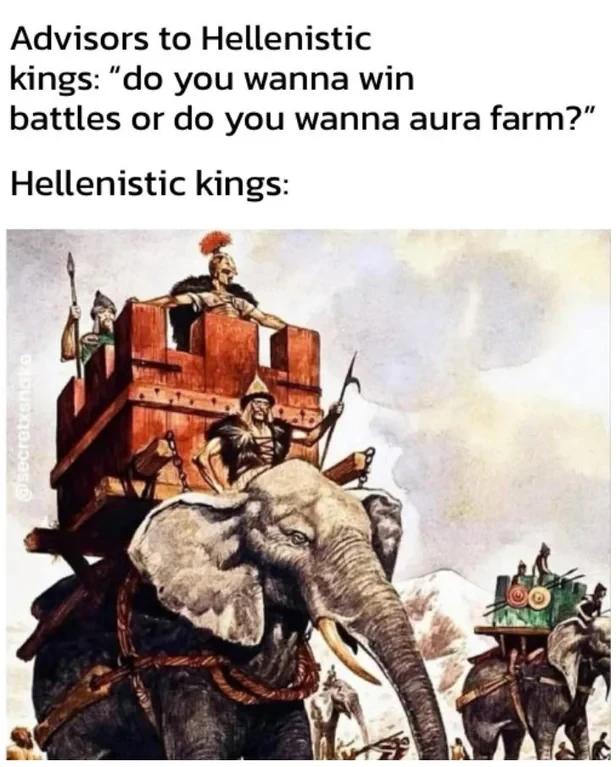

People are often down on the value of elephants on the battlefield but they have so many uses beyond a risky charge.
Just having a mobile viewing platform was useful. They could functional a bit like mobile artillery as well. Hellenistic armies were sophisicated combined-arms affairs, so i think we have to presume they gave militaries options they wanted.
People also forget how incredible elephahts are for logistics & engineering - huge in helenistic warfare. Elephants move trees like nothing else could. Imagine today if only one side in a war had industrial earthmoving equipment.
War elephants were generally used and trained for the charge, or as you mentioned, as a mobile missile platform, like a chariot (but not useless on uneven terrain). A mobile viewing platform is also certainly an advantage - notably, one of the last of the war elephants of the Carthaginian general Hannibal Barca was used by him as his own personal mount so he could survey the battlefield, long after the other war elephants had become casualties of his long campaign in Italy. The elephant in question also only had one tusk, which was fitting for a general who had use of only one eye.
Logistics and engineering, not so much. Hellenistic logistics were painfully primitive, and feeding elephants would’ve been much more logistically troublesome than simply bringing additional mules or horses, if the intent was to use them as pack animals. Elephants are most useful when lifting or carrying things that are individually heavy, like you mentioned, tree trunks. Rations, human-sized gear, firewood, etc? Not so much.
Hellenistic armies were also infamously poor at field engineering, as most of the troops - as middle-class militia or ‘proud’ professional/semi-professional soldier - were averse to manual labor. Siege engineering was a bit of a different question, as rounding up locals to press into service was always an option when your position is going to be static for at least a few days. Hellenistic armies often had the engineering expertise along necessary to design or defeat good defenses; but the lack of manual labor available with their armies meant that such things were rarely considered in the field.
The big problem with elephants boils down to logistics, generally. In Mediterranean conflicts, they need to be transported across the sea - which is not impossible, but extremely troublesome, even compared to transporting horses. In non-Mediterranean European conflicts, they need to be imported entirely. So they only really remained in use in Iran and India, where the supply of elephants was plentiful and near their main areas of campaign, while the imported elephants of the Hellenistic states were mostly useful as shock weapons or simply as propaganda. (North African elephants were not plentiful enough, and eventually used to extinction)
They do be cool af tho. And work elephants were still used in civilian contexts. Just not in Hellenistic and Mediterranean military contexts.
You see tactically elephants go stomp-stomp. What’s gonna beat that!?