But why can you not audit what the LLM creates? You can’t do it for the general case, i.e. prove that for a given prompt it always spits out a valid solution, but you can look at what it actually spit out for your concrete prompt and then you can freely decide, if those code changes are good.
I am of the opinion that a thorough review often takes similarly long to actually writing it yourself, and there’s a high chance that you miss architectural aspects, if you don’t investigate yourself.
But yeah, again, I think you’re taking the comparison too literal.
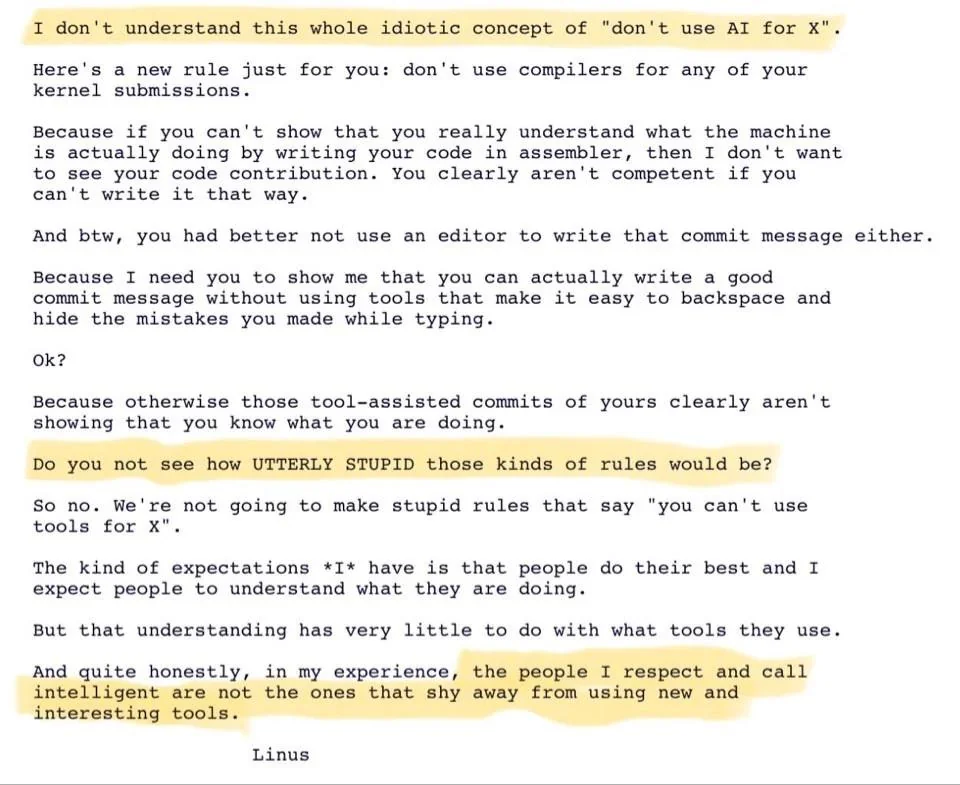
He is just saying that LLMs are a tool. You need to know how to use your tool and produce objectively good results. Then he does not care what tool you use to get there.
You don’t have to do everything with the LLM. Tracing the logical path very much still happens by looking at the code in your editor.
This is also why I’m saying it isn’t much faster. Understanding the existing code and what changes are necessary is the bulk of the work when handwriting code as well.
You *can* tell the LLM to go ham and implement the change on its own and then only look at the diff afterwards, but anyone who thinks they understand the code changes then, is lying to themselves IMHO.


But why can you not audit what the LLM creates? You can’t do it for the general case, i.e. prove that for a given prompt it always spits out a valid solution, but you can look at what it actually spit out for your concrete prompt and then you can freely decide, if those code changes are good.
I am of the opinion that a thorough review often takes similarly long to actually writing it yourself, and there’s a high chance that you miss architectural aspects, if you don’t investigate yourself.
But yeah, again, I think you’re taking the comparison too literal.
He is just saying that LLMs are a tool. You need to know how to use your tool and produce objectively good results. Then he does not care what tool you use to get there.
Auditing typically means tracing the logical path. How do you suggest to do this with an LLM?
I am definitely taking his words literally which is why I disagree with just this one point.
You don’t have to do everything with the LLM. Tracing the logical path very much still happens by looking at the code in your editor.
This is also why I’m saying it isn’t much faster. Understanding the existing code and what changes are necessary is the bulk of the work when handwriting code as well.
You *can* tell the LLM to go ham and implement the change on its own and then only look at the diff afterwards, but anyone who thinks they understand the code changes then, is lying to themselves IMHO.