For anyone unaware, this is a PBS (“Public Broadcasting Service”) show which originated in the States, then spread around the world via various permutations. In other words, it was a wildfire hit that kids and educators everywhere absolutely fell in love with, fast. The goal as I understand it was to help modern kids understand and cope with the world around them, sort of an update from previous shows like Howdy Doody, Andy Devine, and whatever else I’m forgetting. I’ve talked before about how much I venerate Jim Henson.
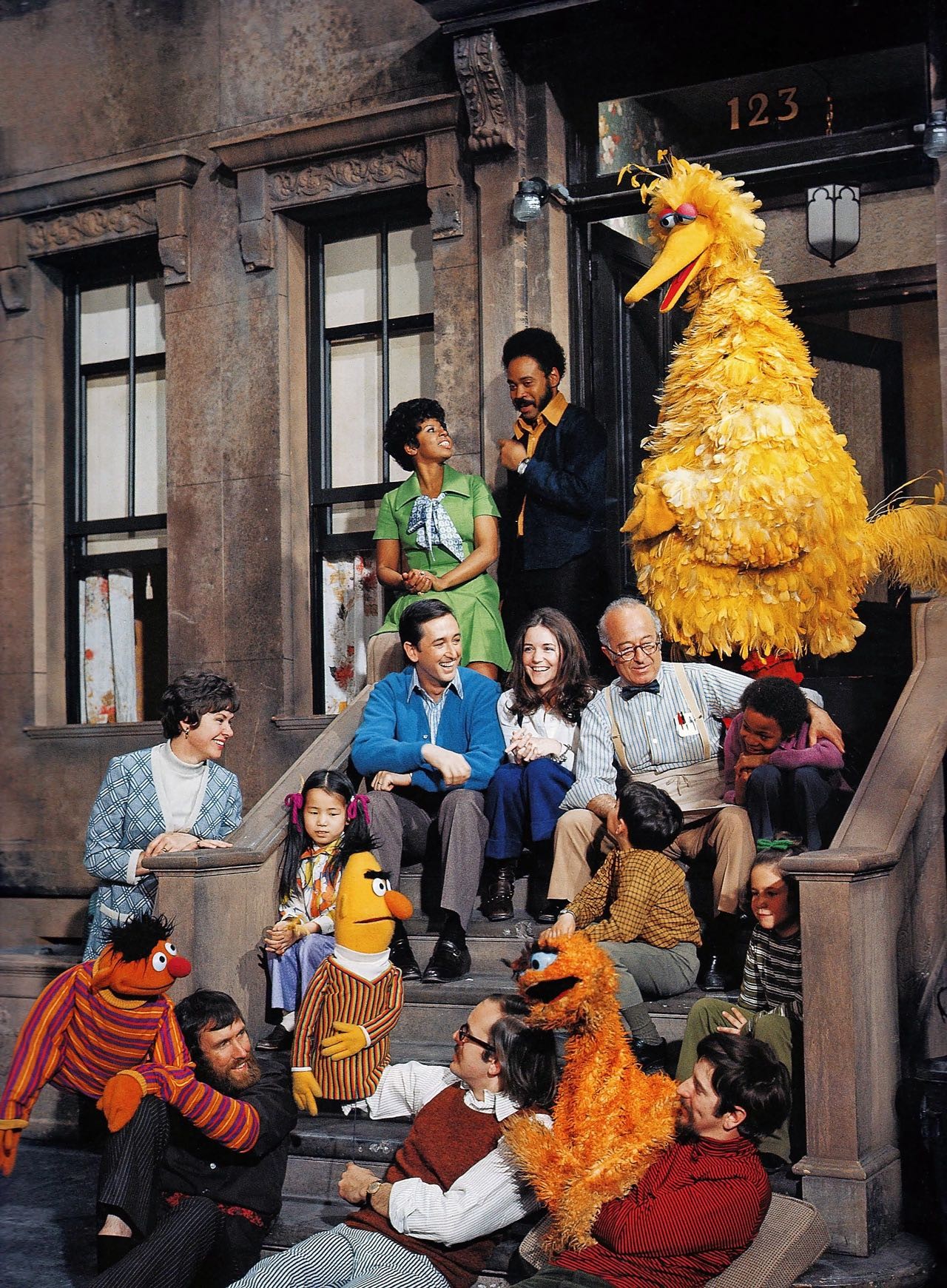
Known human cast: Bob McGrath (Bob), Matt Robinson (Gordon), Loretta Long (Susan), and Will Lee (Mr. Hooper).
Muppets: Big Bird, Bert, Ernie, and an early orange version of Oscar the Grouch (who turned green in the second season).
Performers at bottom: Jim Henson, Frank Oz, and Caroll Spinney, which begs the question-- who the heck’s performing as Big Bird??
@taiyang@lemmy.world adds on:
"Almost there on description but I want to add it also was aimed and oriented towards lower income families in particular, a big reason it takes place in the kind of urban environment you’d grow up in if you were a poor (usually ethnic minority) kid.
"Lots of segments also highlighted things like community resources, like libraries, as well as all sorts of stuff rich people want to defund. But PBS has always been like that, hence why they illegal defunded it last year.
“Quick edit: oh I know a bit about this because of my PhD in education. They did studies on its impact because it was to elevate education outcomes. Iirc, it wasn’t all that effective but that’s mostly because poverty is really, really bad for educational outcomes.”
Some of my earliest memories of Sesame Street was an orange Oscar The Grouch. I’ve argued with people on an off that Oscar was originally Orange, but few believed me. I’m keeping a copy of this on my phone for the next time.
oscar’s original concept was actually magenta but that color didn’t present well on color tv back then. so orange he became. until that ill-fated vacation to swamp mushy muddy.
So you’re saying we only have Elmo because tech got better? GO BACK! GO BACK!
(Just kidding, but as much as Elmo is now a long-time character, because I’m old my time watching the show was WELL before he was around, so he’s sitll new to me lol)
I predate Elmo as well, but I hardly remember that. I also thought Elmo came along a lot later than he did. He has been around since 1980.
Telly walked so Elmo could dance
Elmo is red.
I didn’t even realize that was Oscar, good times
I was confused why big bird was yellow for a long time.
He was green and multicolored in Spanish.
Same here, he’s blue in the Netherlands.
Just a note: PBS stands for public broadcasting service. Afaik, nobody ever uses the initialism for individual shows. Certainly not here in the states
sesame street’s first season was also on NET, the predecessor of PBS.
I did not know that! Cool fact
Right you are. Corrected, thanks.
RIP Mr. Hooper. His death was handled so well on the show. I remember watching those episodes. That is how I learned about death. I was 5 or 6 when it aired.
and Caroll Spinney, which begs the question-- who the heck’s performing as Big Bird??
Caroll Spinney was sick during the taping of a few first season episodes, so Daniel Seagren performed Big Bird in those episodes (including Episode 0083 and 0086). He also performed Big Bird when he appeared on The Ed Sullivan Show in 1969, and in a number of Sesame Street Cast Tours in 1970.
RIP Mr. Hooper. His death was handled so well on the show.
Agreed x10. Even watching it all these years later, it’s still a moving moment. Big Bird in absolute confusion and disbelief until he finally starts to understand.
Does Big Bird make anyone else crave scrambled eggs? His feathers are so egg-like.
That is exactly what his forehead reminded me of when I was a kid.

Exactly you get it.
All I know is that It would take a lot of canary eggs!
(yes, Big Bird is an oversized canary)
Wow I always assumed big bird was some kind of fantasy ostrich
That would be the more logical conclusion, yes. XD
Almost there on description but I want to add it also was aimed and oriented towards lower income families in particular, a big reason it takes place in the kind of urban environment you’d grow up in if you were a poor (usually ethnic minority) kid.
Lots of segments also highlighted things like community resources, like libraries, as well as all sorts of stuff rich people want to defund. But PBS has always been like that, hence why they illegal defunded it last year.
Quick edit: oh I know a bit about this because of my PhD in education. They did studies on its impact because it was to elevate education outcomes. Iirc, it wasn’t all that effective but that’s mostly because poverty is really, really bad for educational outcomes.
It wasn’t just the educational outcomes. It deeply embedded a sense of self worth, that you matter in a world that tries to convince you otherwise. That fighting insurmountable problems is possible and if you are struggling, ask friends for help. That you have value to the world, that’s not measured on what you can provide. You just matter because you exist. Everyone deserves love. It made you feel welcome and loved. It made you feel like there was a place for you in this world. Theres so much more. Those are powerful tools and qualities to give.
In actuality, yes, and I imagine that was the vision many who worked in the show had. I’m mostly referring to the “on paper” arguments made for the PBS funding and whatnot.
And to be fair to Sesame Street, it’s not like a television program can undo years of segregation, redlining, broken homes, and whatnot; but I like to believe it makes some difference given there’s a lot of statistical noise in those kinds of studies.
Great info! I’ll link / requote it above.
Based on what you wrote, it also makes me curious if Henson had any regrets about Sesame Street. That is, his career could have gone in almost any direction at that point, and he’d already done all kinds of work by 1969, but the show certainly locked up a bunch of his time, energy and creativity for years. Sure, he was able to launch lots of other projects in time, but my sense is that his career might have gone a lot differently without Sesame Street.
For example, his other work could be a lot darker and non-children-oriented at times. Even the Muppet Show promo had a sex theme. For example, I’d previous posted about him HERE, which includes a short, experimental film by him.
I can’t imagine he’d regret it, but you’re right that his career would be very different. But I think most people who worked on the show were passionate about helping children learn, and I imagine that’s no different for Henson.
I wish I could remember the material I read about this, but it was years ago. Otherwise you’d have a better source than my memory! It’s also a little funny that it reached such a secondary audience, including wealthy families (who were presumed to have better options like tutors).
I wasn’t proposing overall regret, and I’d be very surprised to learn if that was the case. More like-- “this part of the show could be a bit of a drag for me” and “I really wish I’d had more time for X project.” That kind of thing. I mean, just his overall thoughts on the show, pros, cons & insider stories would be interesting, and indeed… maybe there’s a book or something.
Also belongs on oldschoolcool.
Feel free!
I was there, barely half of them were real
It’s the 60s so probably even Mr Hooper was still in his twenties there.
Uh, mate… Mr Hooper is the guy in the shopkeeper’s garb.
He was in his 80s when he died in 82. That would have put him in his 60s here.
Edit: turns out the actor was 58 when Sesame Street premiered, and was 74 when he died.
Komm süsser Tod
Where’s George Carlin?
I don’t get it. Why would George Carlin be there?
He was there at some point wasn’t he? I remember him as Mr. Conductor for Thomas the tank engine.
Yeah, that was a different show 20+yrs later, to be clear.

He was also the narrator.