

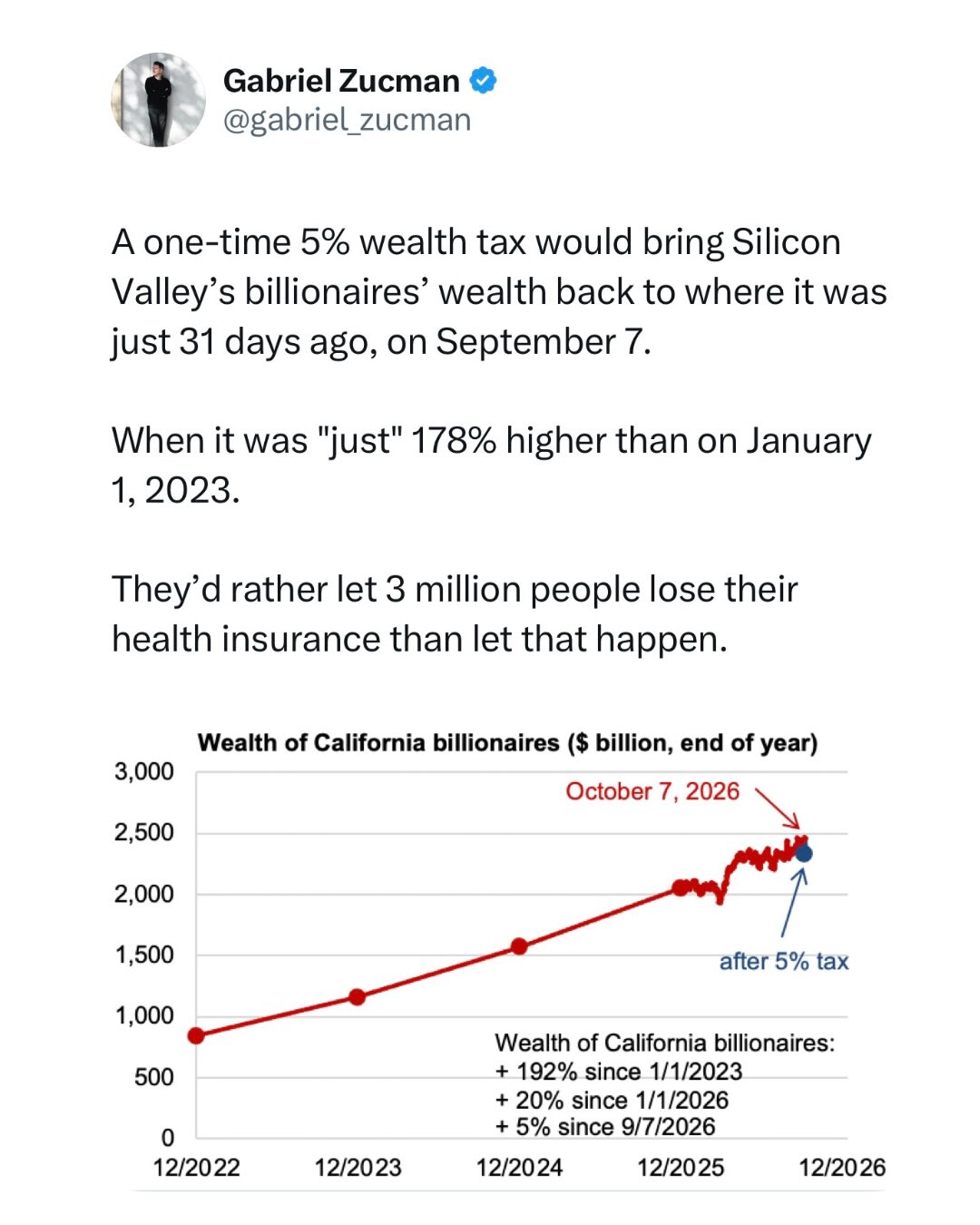
A one-time 5% wealth tax would bring Silicon Valley’s billionaires’ wealth back to where it was just 31 days ago, on September 7.
When it was “just” 178% higher than on January 1, 2023.
They’d rather let 3 million people lose their health insurance than let that happen.
Graph here: https://cabillionairetracker.org/
Rather than paying their fair share of taxes, Sergey Brin, Pether Thiel, and Patrick Collison prefer to spend tens of millions to manipulate the vote.
Stupefying levels of greed and lack of civil-mindedness.
$45 million in a week: California’s wealthy aren’t holding back to try to stop ‘billionaire tax’
All credits to Gabriel Zucman
This is a legitimate problem. Forcing a primary shareholder to sell their shares devalues the shares of workers holding them in retirement accounts. Forcing them to liquidate their shares is not at all feasible.
Which is why this tax should never be payable in dollars. It should be paid directly in shares. It doesn’t have to be converted to cash first; the shares themselves go straight to the IRS.
The confiscated shares can be liquidated slowly over time. Every time 1000 shares are traded on the free market, the IRS gets to offer one of its taxed shares. The influence on the market price of the shares is minimized. If the shares become worthless, they just sit on the IRS books, collecting dust forever.
I’d only tax securities - investment holdings. Stocks, bonds, other fungible, intangible, financial assets. I want them spending their money on tangible products and personal services (as opposed to financial services) that are ultimately produced by workers. I want them pushing their money back into rotation, not setting up dollar farms to collect it from everything that moves.
But, if we want to go after general wealth, we can also do the same thing for deeded property or titled property. They don’t have to sell the land or the car/boat/plane; we just put a tax lien on it now, and collect later.
I like it, but I would prefer if the government kept the share of the companies, transitioning the companies into government run entities over time, thereby having the production be owned by the people.
Absolutely not: Trump, Trump, Bush, Bush, Bush, Reagan, Reagan, Ford, Nixon, Nixon.
We’ve seen what these bastards did to the postal service and everything else they’ve touched. We’re not putting every major industry in the country under the direct control of men like these. The idea of government-run commercial entities is simply a non-starter. That’s one of the few qualms I have about the IRS holding these shares for any length of time. I would strip control and voting rights from these taxed shares, restoring them only once they have been transferred to a market buyer.
I agree that ownership of production needs to be in the hands of the people, but that ownership needs to be directly in the hands of the people, not through a stake in a government that is, more often than not, overtly hostile and malicious to the interests of the people.
The tax would apply to ALL stocks, bonds, and other financial instruments. Natural US persons can exempt up to $10 million worth from their portfolio, but they will owe an equal proportion of every issue in their portfolio: They don’t get to pick and choose what issues they will keep and what they transfer to the IRS: The IRS gets the same percentage of everything.
The artificial persons owe the full tax: no exemptions. If you own $100 million in stocks, you can’t split it up among 10 companies. You can split it up among friends and family to avoid the tax, but they each control their own shares.
To the working class, securities remain a valuable asset. To the ultra-rich, a sufficiently-high tax converts these same securities into an expensive liability. With these conditions, an ownership stake in a worker’s company will become a significant component of their compensation. Ownership of production will be driven away from the ultra-wealthy and to the people.