
From Henrik Nilsson
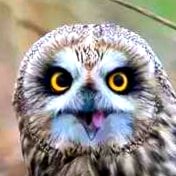
Short eared owls seem like they can turn on a dime. Here, an owl changes direction as it detected a vole in the marsh below.
British Columbia, Canada.
Canon 7D with Canon 500mm f4. 1/2000 sec, f5, ISO 400. Mar 2011.

I honestly picture it working a lot like this. Simple, specific task focused brains. Lots of data to compile on visual and sonic clues. Feels like it should be automatic behavior that’s more instinctive and reactive than thought based and contemplative.
Do they always keep their head level with the horizon?
I believe they’re usually going to be facing forward since their eyes are in a fixed position. They can only look straight ahead (their eyes are too large to move in their skull, and they aren’t round either so they cannot physically move, hence the famous head rotation around either axis).
They will rotate their heads to focus visually or sonically on something that catches their interest, like prey or a photographer they spot, but otherwise I think they’ll be focused on not running into things. They’re not normally long distance flyers, most hunt from a perch and just hang out there until they see food and swoop in. They’ve traded a lot of flight efficiency for specialized silent flight, so they’re not often built to fly far for long periods.
Short ears are a good example of ones that do often get caught looking toward the camera, likely because they hunt in open grassland and don’t have as many objects to worry about as their wooded relatives.


