Explanation: The Spartans at Thermopylae are often lionized for fighting against a numerically superior force of Persians at a strategic chokepoint. There were, famously, 300 Spartans - less famously, there were around ~3000 other Greek troops as well (seems they drew the short straw when popular narratives were being made) - who fought against a Persian force which outnumbered them by at least a degree of magnitude. They eventually were outflanked and killed, but gained a reputation for bravery by their enduring resistance.
The Romans at the Battle of Watling Street, on the other hand, faced down between 100,000-200,000 Britons, thus being outnumbered 10-1 or 20-1… and came out with only a few hundred casualties, having entirely routed the enemy army.
Now, there is an actual reason, other than Gr*ek sympathizers infesting academia, that the two battles did not become quite equally famous for being outnumbered.
First and foremost, despite the Persians being unfairly slandered in many depictions, and the Greeks glazed, the Battle of Watling Street is much harder to portray as “OUTNUMBERED PEOPLE HEROICALLY RESIST FOREIGN CONQUERORS” than Thermopylae. The rebellious Britons were led by a Briton queen who had been legitimately wronged by the Romans - something even the Roman accounts admitted - and rallied native Briton forces against the ruling Roman administration. The Britons committed atrocities themselves, and were largely fine with collaborating with Roman rule for the previous ~20 years - not to mention that the Briton loss was an ignominious rout rather than a heroic last stand to-the-death - it’s far from the neat narrative Thermopylae - which even the most pro-Persian accounts must admit is “Imperialist power vs. Natives of the region trying to resist” - offers.
Second, that the two sides were not qualitatively equal. In Thermopylae, professionals/nobles (Spartan troops and the Persian Immortals) clashed, each side supported by a much larger number of militia and levies. Whatever the exact advantage one wishes to give the soldiers of one side or the other, it’s generally agreed to not be a massive difference in troop quality, on average. At Watling Street? The Romans were 20-year term professionals in an institution with generations of combat experience maintained and passed down, equipped with the best gear civilization could imagine at the time. The Britons were militia at best, with many of the best warriors already serving the Roman Empire (elsewhere in the Empire, mind you) and unavailable for their rebel army, who had only been called together for a few months, very little of which had been spent training or practicing maneuvers together.
Third, that the eventual outcome was… not particularly exciting. In Thermopylae, despite the defeat, the Greeks rally to (eventually) push out the vastly larger Persian Empire from Greece. Even in defeat, resistance plants the seeds of victory! In Watling Street, the vastly larger Roman Empire, having won over the rebellious Britons, proceed to… occupy Britain, as the plan always was, and as they had done for the past 20 years. Not exactly a shocking turn of events.


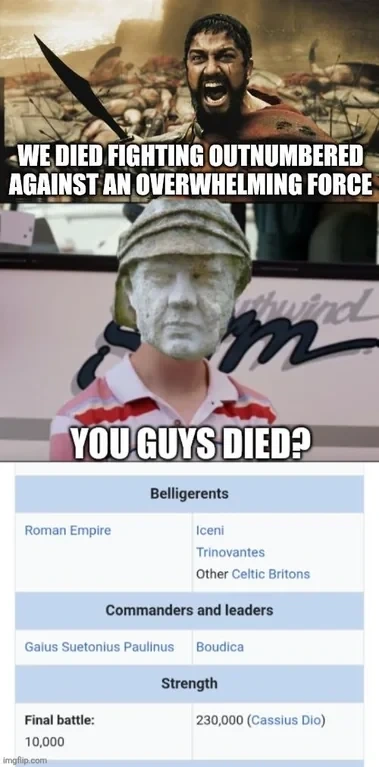
Explanation: The Spartans at Thermopylae are often lionized for fighting against a numerically superior force of Persians at a strategic chokepoint. There were, famously, 300 Spartans - less famously, there were around ~3000 other Greek troops as well (seems they drew the short straw when popular narratives were being made) - who fought against a Persian force which outnumbered them by at least a degree of magnitude. They eventually were outflanked and killed, but gained a reputation for bravery by their enduring resistance.
The Romans at the Battle of Watling Street, on the other hand, faced down between 100,000-200,000 Britons, thus being outnumbered 10-1 or 20-1… and came out with only a few hundred casualties, having entirely routed the enemy army.
Now, there is an actual reason, other than Gr*ek sympathizers infesting academia, that the two battles did not become quite equally famous for being outnumbered.
First and foremost, despite the Persians being unfairly slandered in many depictions, and the Greeks glazed, the Battle of Watling Street is much harder to portray as “OUTNUMBERED PEOPLE HEROICALLY RESIST FOREIGN CONQUERORS” than Thermopylae. The rebellious Britons were led by a Briton queen who had been legitimately wronged by the Romans - something even the Roman accounts admitted - and rallied native Briton forces against the ruling Roman administration. The Britons committed atrocities themselves, and were largely fine with collaborating with Roman rule for the previous ~20 years - not to mention that the Briton loss was an ignominious rout rather than a heroic last stand to-the-death - it’s far from the neat narrative Thermopylae - which even the most pro-Persian accounts must admit is “Imperialist power vs. Natives of the region trying to resist” - offers.
Second, that the two sides were not qualitatively equal. In Thermopylae, professionals/nobles (Spartan troops and the Persian Immortals) clashed, each side supported by a much larger number of militia and levies. Whatever the exact advantage one wishes to give the soldiers of one side or the other, it’s generally agreed to not be a massive difference in troop quality, on average. At Watling Street? The Romans were 20-year term professionals in an institution with generations of combat experience maintained and passed down, equipped with the best gear civilization could imagine at the time. The Britons were militia at best, with many of the best warriors already serving the Roman Empire (elsewhere in the Empire, mind you) and unavailable for their rebel army, who had only been called together for a few months, very little of which had been spent training or practicing maneuvers together.
Third, that the eventual outcome was… not particularly exciting. In Thermopylae, despite the defeat, the Greeks rally to (eventually) push out the vastly larger Persian Empire from Greece. Even in defeat, resistance plants the seeds of victory! In Watling Street, the vastly larger Roman Empire, having won over the rebellious Britons, proceed to… occupy Britain, as the plan always was, and as they had done for the past 20 years. Not exactly a shocking turn of events.
Thanks a lot for the explaination