

I proposed this project to improve on Radicle’s p2p model by using Tor for universal, straightforward seeding of git repos.
Original discussion thread - https://bounties.monero.social/posts/207/
One of the project’s git repos linked in that thread - https://radicle.network/nodes/iris.radicle.network/rad:z2ydYmUCJvDfNFTVTpEbQmm55EPt1/history
Project website - https://cradicle.xyz/
The dev who took the project also expanded it into a project to reimplement Radicle in C.
Since I’m not a coder and I don’t have any git repos of my own, I can only test from the viewpoint of an average layman using the GUI app to seed repos.
It’s impossible for me to properly gauge how the project is progressing without engagement from coders who try using it for their git repos.
If the project doesn’t currently interest you, your suggestions on how to start getting users on board would also be welcome.
Edit - bear in mind that because decentralized discussion platforms like this are currently quite broken, there are comments showing up in the thread when I’m not signed in that don’t show up for me when I’m signed in. Here’s a screenshot of all the comments showing up for me right now where I’m signed in and able to reply, as of UNIX time 1779670288
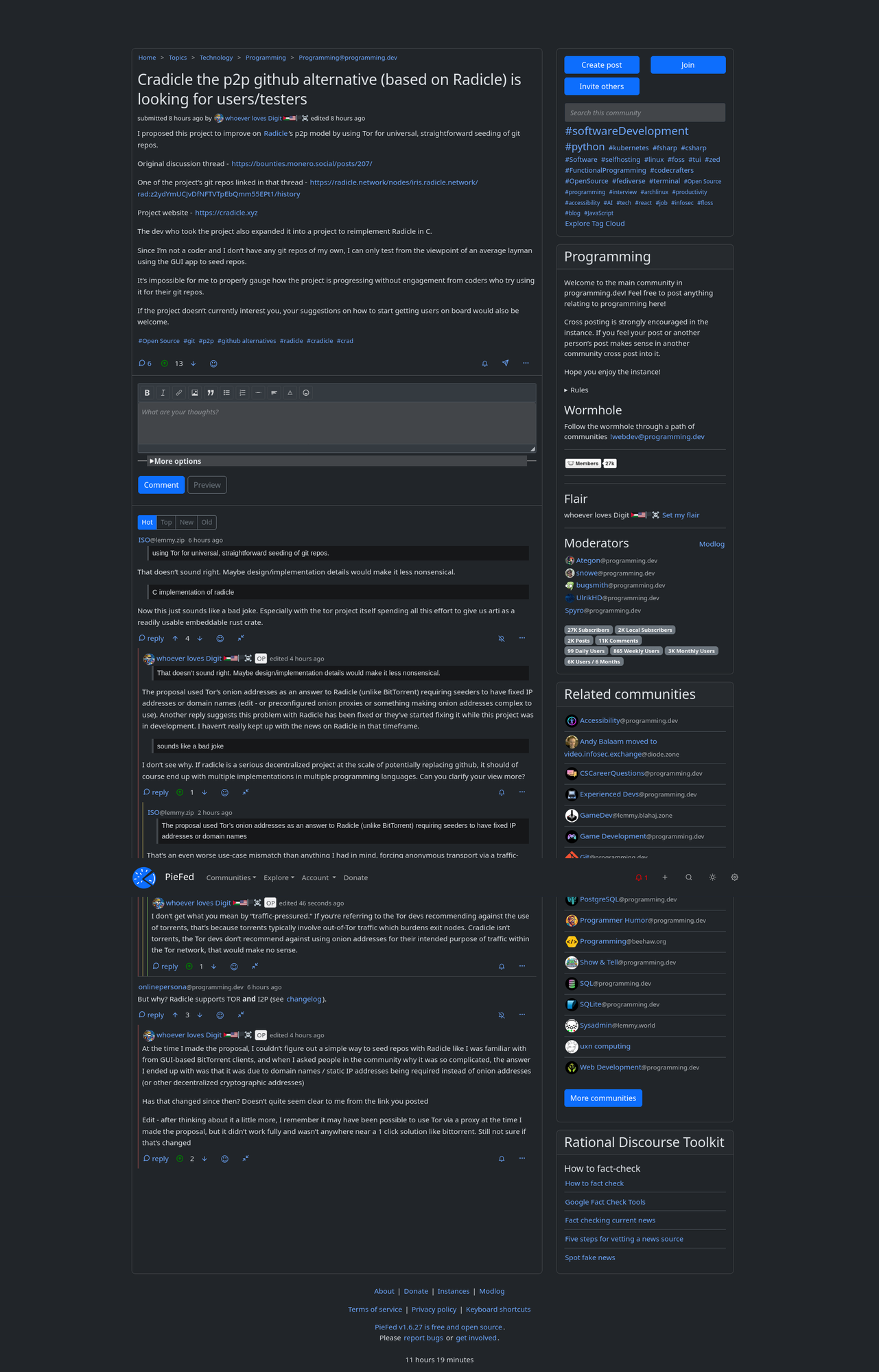
I’d encourage discussion of this project moreso on nostr (equally broken but my preferred platform) or the discussion thread linked above (seemingly more functional)
P2P already gives you anti-censorship. Publisher anonymity shouldn’t be hard for developers to achieve either.
If full network anonymity is desirable, then you would need a full top-down design to do it properly, and this becomes a whole different conversation (and the choice of using bittorrent itself will have to be revisited). But really, I don’t think that’s needed here.
Pluggable transports can still be useful for varying reasons of course. I don’t think anyone would argue against them.
But I would still opine that forcing a slow network on any forge alternative is the fastest way to keep 99% of potential users away.
until a lawyer joins the swarm and has the IP of every node. See which node pushes commits to the swarm first, and you found the dev. Send a couple of threats to the dev and watch the project grind to a halt.
Plugging into Tor or I2P is a easy way to give network anonymity, no need to re-invent the wheel. Though it seems like Radicle already supports Tor and I2P so not entirely sure what OP aims to do
How do you send a threat to an IP address? 😏 about supposed push of code encrypted no less. Unless, you’re thinking ISP involvement, that would be a hilarious (single) e-mail to read (from the “lawyer” to the ISP, because there will be no other correspondence).
If the threat model is “lawyer”, developers will be fine. If it’s a “state actor” and/or all users need protection, then again, this is a whole other conversation. If it’s something in between, then yes, maybe developers/publishers should specifically be careful, and/or maybe the design of the software should help them, but without compromising the performance of the whole network. But again, bittorrent will not be the right protocol for this anyway.
There’s many ways to track somebody down via IP address, but yes ISPs can corroborate. You ever heard of people getting letters from the ISP for torrenting? You think the ISPs actually care about piracy? They are forced by legal pressure.
The threat model is massive fines and potential prison, depending on how the court case goes. Look up the Yuzu nintendo switch emulator and how that legal battle went. And I’m not arguing that those developers were the brightest of the bunch. I’m saying that those developers could use the privacy that Tor offers.
Bittorrent works well enough. Bittorrent works fine over I2P and is used plenty. Better to get something up and running before starting to design bespoke protocols.
🤣
I deliberately mentioned this because that “program”, as you would expect, ended up as a failed meme, which is why it’s sadly no longer with us.
And it wasn’t about people seeding their own code, or code otherwise allowed to be redistributed, anyway.
I actually know somebody that was fined quite a bit for torrenting, so idk what you mean by failed meme. The ISP absolutely does collaborate with copyright lawyers. So if copyright lawyers with enough money want to take down a nintendo switch emulator, and they got the IP of the dev, they cound find the real person behind it easily.