Explanation: While usually less egregious than literal dreams (though many ancient peoples put high stock in dreams!) the standards of ancient historians for what counted as a reliable source were… not always as high as modern standards.
On the other hand, Roman historiography in particular valued sourcing very highly, and would sometimes legitimately cite their sources (not MLA though - see me after class) in their writing, mentioning specific letters in the public archives or traveling to regions (or mentioning others who had) to cite recorded edicts still publicly posted in the local towns.
A funny convergence of these two is the infamously unreliable Historia Augusta in the Late Empire, as everything was falling apart. Nonetheless, it cites sources, letters, and locally posted edicts… many of which are pretty blatantly made up, lmao. But it SOUNDS convincing in the Roman historiographical tradition, so it must be true!


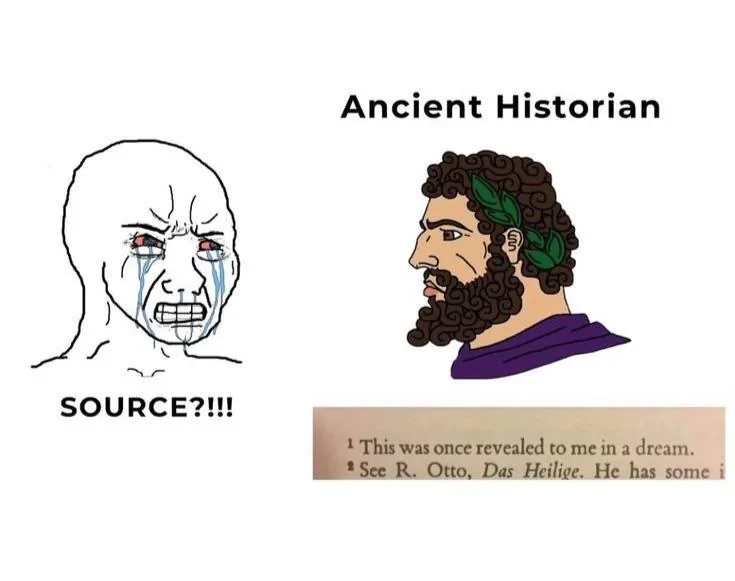
Explanation: While usually less egregious than literal dreams (though many ancient peoples put high stock in dreams!) the standards of ancient historians for what counted as a reliable source were… not always as high as modern standards.
On the other hand, Roman historiography in particular valued sourcing very highly, and would sometimes legitimately cite their sources (not MLA though - see me after class) in their writing, mentioning specific letters in the public archives or traveling to regions (or mentioning others who had) to cite recorded edicts still publicly posted in the local towns.
A funny convergence of these two is the infamously unreliable Historia Augusta in the Late Empire, as everything was falling apart. Nonetheless, it cites sources, letters, and locally posted edicts… many of which are pretty blatantly made up, lmao. But it SOUNDS convincing in the Roman historiographical tradition, so it must be true!
Oh jeez oh no can I not see you after class
Chicago style supremacist here. MLA? APA? Psyops!