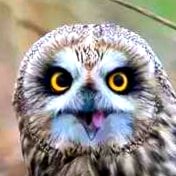


From ANIMA
An owl with fractures in both tarsometatarsals, just woke up from surgery. The fractures were repaired with external osteosynthesis.
Original Greek Text
ΑΝΙΜΑ - Σύλλογος Προστασίας και Περίθαλψης Άγριας Ζωής Φ
Μπούφος με κατάγματα και στα δύο ταρσομετατάρσια, μόλις ξύπνησε από το χειρουργείο. Τα κατάγματα αποκαταστάθηκαν με εξωτερική οστεοσύνθεση.

External osteosynthesis uses pins through the bones that are stabilized by an external structure, in the case of birds, it seems common to use some type of acrylic for weight reduction, while on dogs and humans, it looks like metal framework is used.
For an area like the tarsus, there isn’t much soft tissue. It’s mainly just bone and tendons, so not having to cut into the leg to repair it keeps the chance for further damage to anything in that part of the leg.
Here are some other reasons to use external fixation on birds from a bird surgery textbook I found.
Bony injuries in the avian patient tend to heal in a reasonable manner and are amenable to a variety of fixation methods. In contrast, maintenance of soft tissues and joint mobility, the most vital components of return of full function for birds, may be hindered by many of the techniques used for immobilization of fractures and luxations. External fixators are generally considered the best stabilization technique for immobilizing fractures in birds that require a full return to function.
Numerous types of external been described for use in birds. A variety of Kirschner wires and Steinman pins may be passed into the bones, and a variety of connecting bars and acrylic cements can be used for stabilizing the pins. These devices are inexpensive, light-weight, easy to remove and are well tolerated by many avian species. An external fixator can be easily removed from a calm patient without anesthesia. When properly used, external fixators provide rigid stabilization and preserve joint and periarticular structure, while neutralizing rotational, bending and shear forces. The approach to the surgi- cal site can be minimal and, therefore, decreases soft tissue damage and reduces post-fixation dysfunction of the limb. In many cases, external fixators allow a bird to use a repaired limb within several days of surgery.
If that is too dry, I found a more in depth but not as dense as the textbook story about a pelican with the same injury as the owl that goes more in depth.
Nothing graphic on the pelican link. Textbook has some pictures, all external, that may not be for the squeamish.
I angy.
Only fair. That owl’s had one heck of a day!