

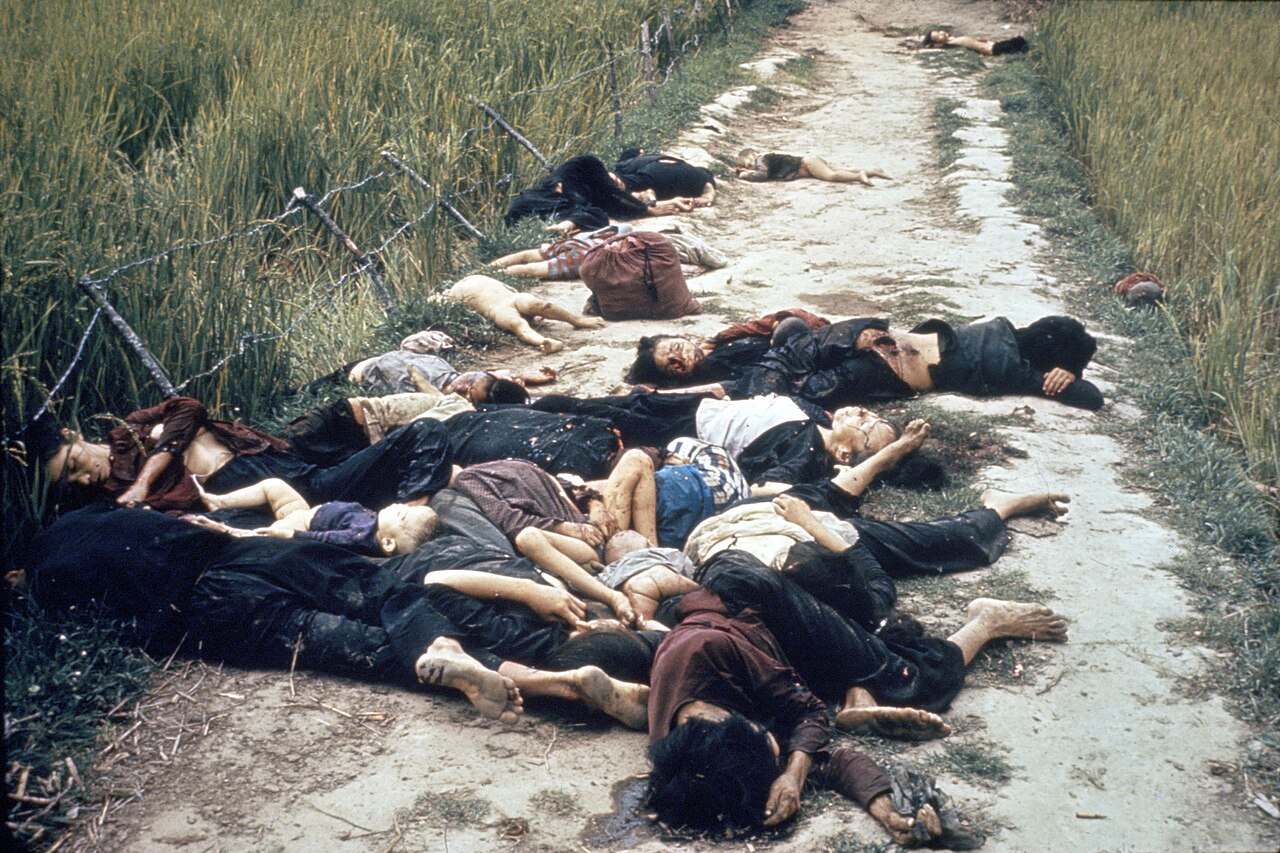
At least 347 and up to 504 civilians, almost all women, children and elderly men, were murdered by U.S. Army soldiers. Some of the women were gang-raped and their bodies mutilated, and some soldiers mutilated and raped children as young as 12.
only Lieutenant William Calley Jr., the leader of 1st Platoon in C Company, was convicted. He was found guilty of murdering 22 villagers and originally given a life sentence, but served three-and-a-half years under house arrest after his sentence was commuted.
Research has highlighted that the My Lai Massacre was not an isolated war crime. Nick Turse places it within a larger pattern of American atrocities enabled by deliberate policies from commanders, such as “free-fire zones” and “body counts”, as well as widespread racism amongst American military personnel. Many other atrocities were also covered up by commanders.
Why you should know about this: It is important to know about history so that we can learn from it, avoid the mistakes and atrocities of the past, and know which institutions have a history of performing atrocities, trying to cover them up, etc. and what that looks like.
So a few ideas. Saying agree to disagree is an easy way out if a subject is triggering. They say a broken clock (analog lol) is right twice a day. Even a flat earther could say something that is true in their argument, or even have an interesting idea that might lead somewhere. So while dismissing themmis the easy way out, and it is okay to take the easy way sometimes, it still isn’t the best way. And yes, we are all flawed, I have no shortage of flaws myself.
On the topic of justifying. I’m not trying to justify actions. I am trying to say we should expect them and not be surprised by them. We shouldn’t assume the person is just completely evil, but that they are too weak to do better, to do what is right, and they have succumb to ancient instincts that are no longer needed, but still exist nonetheless. Humans are mostly driven by chemicals they can’t control.
Ass for spain. I agree that if a group manages to hit critical mass, it can for a time operate as under anarchist ideals. But one of the ways it was accomplished in spain was that those who didn’t share those ideals could leave. And many of such people were also the ones dieing in the civil war. So it is almost like selecting a group by eliminating those of a certain opinion, and allowing any left to leave if they want. In the end, those of that differing opinion are simply outnumbered. And humans are known to go with the flow. That is why too many put up with dictators they don’t believe in. It can work in a small cut out of society. But to do it for the whole of society would require getting rid of a significant amount of the capitalist. Which is why I say, not enough of us have evolved past that drive for power and influence yet, for it to work. And I wish I knew how to speed it up. But progress will slow down when it happens. And thats okay. The overhead of communication and such is just much highed when organized by committee versus a single leader. Ifeally we find a way to elevate leaders who aren’t in it for the power and influence. But that is very hard.
It’s the best way for me. I’m guessing you don’t have experience with PTSD, but if I get into an argument with someone about a topic which is triggering, for the next day or so, I won’t be able to sleep, I’ll have hallucinations of terrifying things which aren’t there, panic attacks that come out of nowhere, cold sweats, flashbacks… I could go on. I don’t care if someone might possibly have one good idea amongst all of their bad ones if that is the cost.
Yes, of course, that is absolutely a foundation stone of anarchism: voluntary association. Everyone must always be free to associate, or not, as they see fit.
True capitalists who actually own capital are vanishingly few compared to the working class. They’re a rounding error. We do not need to get them on side to succeed. They can go off and do their own thing if they want to, have a real Atlas Shrugged society in a mountain. In reality, they need us, so once there is a critical mass, they will either join our society, or learn to work for themselves, rather than by exploiting others.
If you’re talking about self-serving behavior, I understand what you mean, but anarchism is actually completely compatible with self-serving behavior. In fact, one of the major traditions of anarchism, egoist anarchism is entirely centered around that concept.
Finally, the “drive for power and influence” isn’t in our nature, but it is rather a response to environmental conditions. Do you see an elephant at the circus and assume that juggling balls must be in an elephant’s nature? If we change the system of incentives which govern our society, human behaviors will change and adapt to match.
This can never, ever work. Even if you find people who aren’t in it for that, they will almost definitely always be corrupted. Power corrupts. That is one of the founding principles of anarchism.
I do understand your ptsd comment, though I have not experienced anything that severe.
I don’t think that a capitalist has to actually own capital to contribute to the problem. So I think there are a lot more people that will keep it going hoping to become someone who owns the capital. I believe the phrase is “power abhors a vacuum”
And I do agree that power corrupts. Maybe not 100% of the time, but a lot. The idea though is that is we elect people who are in it for the people, when they do get corrupted, it will be far more likely they can be removed. Kind of a checks and balances thing.
Overall, I do like the idea of enclaves. Give people a choice of how they want to live. But the problem is that the capitalist can’t resist finding a way to exploit all the rest.