Can you explain me why there is such hate against snaps? (Honest question). I switched over a year ago from windows to kubuntu and realized that multiple flatpaks have problems with strange behavior like handling notifications correctly, but snaps didn’t. So it was nice to have an alternative source. But thats the user point of view.
For me, the issue with Snaps are that they are coupled so tightly with Ubuntu that they don’t work well on other distros, especially if your distro doesn’t use AppArmor and uses SELinux or other security systems instead.
I also dislike that Canonical went out of their way to remove flatpaks from all Ubuntu spins and they have hardcoded apt to install snaps for certain apps like Firefox instead of actually system deb package like apt is expected to do. That is deliberately misleading users.
Another thing that contributes to the average distaste was that, early on, Snaps had a terrible spool up time. It was so bad that many people thought their applications were broken. While that is no longer the case, the stigma from those early slow and buggy Snaps, like the Firefox snap, is still there.
Run mount or df on a sane distro. Reasonably small list of mounts. Now run it on a distro with snaps. You get an insane list of every app you’ve installed. It’s a gory mess.
For me, one thing is that interoperability between applications can be screwed. For example, when I was on Ubuntu, firefox came as a snap and I could not get the integration with my password manager going easily.
I also had some tooling to make tiny boot media from a fairly typical boot distribution, but snaps really blew up the concept.
I didn’t dig too deeply, but at first blush snap seemed tied to Canonical’s “store”, while flatpak wasn’t particularly locked in to any registry.
Also, at least at one point they were saying they were going to package everything as a snap, up to and including the kernel. Which means at some point I wouldn’t be able to tell if a snap would be something isolated by container mechanisms or just a traditionally run payload. I don’t know if anything like that came to pass for real since I left them behind at that point.


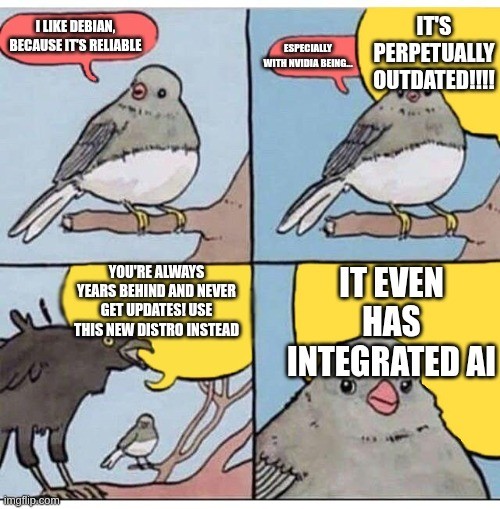
Ubuntu is al…
SNAPS! YOU HAVE TO USE SNAPS!!!
Can you explain me why there is such hate against snaps? (Honest question). I switched over a year ago from windows to kubuntu and realized that multiple flatpaks have problems with strange behavior like handling notifications correctly, but snaps didn’t. So it was nice to have an alternative source. But thats the user point of view.
For me, the issue with Snaps are that they are coupled so tightly with Ubuntu that they don’t work well on other distros, especially if your distro doesn’t use AppArmor and uses SELinux or other security systems instead.
I also dislike that Canonical went out of their way to remove flatpaks from all Ubuntu spins and they have hardcoded apt to install snaps for certain apps like Firefox instead of actually system deb package like apt is expected to do. That is deliberately misleading users.
Another thing that contributes to the average distaste was that, early on, Snaps had a terrible spool up time. It was so bad that many people thought their applications were broken. While that is no longer the case, the stigma from those early slow and buggy Snaps, like the Firefox snap, is still there.
Run mount or df on a sane distro. Reasonably small list of mounts. Now run it on a distro with snaps. You get an insane list of every app you’ve installed. It’s a gory mess.
Snaps are closed source - the antithesis of the Unix community - and an attempt by Canonical to entrap same into their zeitgeist.
For me, one thing is that interoperability between applications can be screwed. For example, when I was on Ubuntu, firefox came as a snap and I could not get the integration with my password manager going easily.
I also had some tooling to make tiny boot media from a fairly typical boot distribution, but snaps really blew up the concept.
I didn’t dig too deeply, but at first blush snap seemed tied to Canonical’s “store”, while flatpak wasn’t particularly locked in to any registry.
Also, at least at one point they were saying they were going to package everything as a snap, up to and including the kernel. Which means at some point I wouldn’t be able to tell if a snap would be something isolated by container mechanisms or just a traditionally run payload. I don’t know if anything like that came to pass for real since I left them behind at that point.